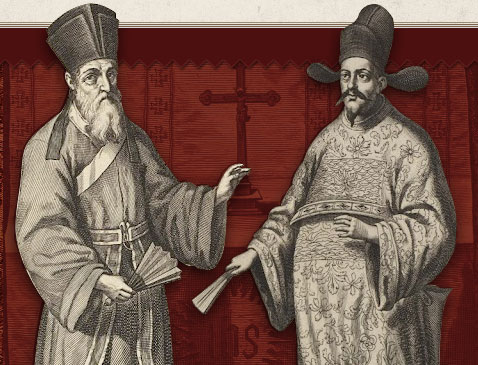
| Author | Martini, Martino 衛匡國, 1614-1661 |
| Place | Antverpiæ [Antwerp] |
| Publisher | Ex Officina Plantiniana Balthasaris Moreti |
| Collection | Ricci Institute Library |
| Language | Latin |
| Type | Book |
| Shelf | Rare Books, Room 103C |
| Call Number | DS754.M38 1654 |
| Description | 156, [3] : illus. ; 16 cm |
| Note | De bello Tartarico historia : in quâ, quo pacto Tartari hac nostrâ aetate Sinicum imperium inuaserint, ac ferè totum occuparint, narratur, eorumq́ue mores breuiter describuntur / Martino Martini Donation in 2026 |
| LCCN | 47037642 |
| Author | Chen Min-sun |
| Place | Chicago |
| Publisher | --- |
| Collection | Ricci Institute Library |
| Language | English |
| Type | Thesis/Dissertation (PDF) |
| Shelf | Digital Archives |
| Call Number | DS754.C5477 1971d |
| Description | dig.pdf. [iii, 250 leaves] |
| Note | Three contemporary western sources on the history of the late Ming and the Manchu conquest of China / by Min-sun Chen. Thesis (Ph. D.)--University of Chicago, Dept. of History, March 1971. Includes bibliographical references (leaves 243-250). Local access dig.pdf. [Chen-Three Contemporary Sources.pdf] |
| Author | Giovannetti-Singh, Gianamar |
| Collection | Ricci Institute Library |
| Language | English |
| Type | Article (in Periodical) |
| Shelf | Digital Archives |
| Call Number | DS754.G568 2025 |
| Description | 26 p. |
| Note | "Wild horses: Tartar warfare and the history of civilization" / Gianamar Giovannetti-Singh Published in Annals of Science, v. 82, issue 3 (2025) Also available through Boston College Libraries Abstract: In 1644, the Manchus, a Tungusic population from northeast Asia, conquered Ming China, establishing the Qing Empire. Four years later, Crimean Tartar horsemen joined a major uprising against the Polish-Lithuanian Commonwealth, gravely destabilizing one of Europe’s largest states. These near-simultaneous incursions by ostensibly nomadic, horse-riding ‘Tartars’ into firearm-defended sedentary states generated extensive historiographical reflection on the role of nomads and their warhorse-centred armies in shaping human history. This article explores how the Jesuit Martino Martini drew on these Tartar wars to articulate a dialectical theory of human history, oscillating between civilization and barbarism, respectively embodied by agriculturalism and nomadic-pastoralism. Such theories, I argue, emerged in dialogue with pressing concerns about military security in metropolitan Europe. Indeed, the shock of the near-simultaneous Tartar wars spurred European writers to critically examine their own states’ defences, contributing to controversies between Ancient and Modern military technologies. As this article shows, several Europeans came to construe Tartars simultaneously as ‘barbarians’ and a source of valuable martial expertise to be studied and selectively appropriated. |