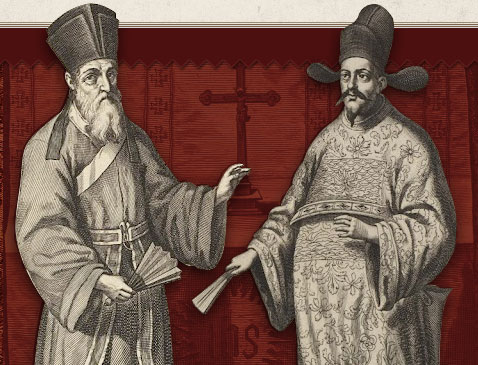
Author: Givon, Yuval 峰尤瓦

tale of dynastic change in China : the Ming-Qing transition through Athanasius Kircher SJ's China illustrata (1667). [AHSI vol. lxxxviii, fasc. 175 (2019-I)]
Date2019
Publish_locationRomae
PublisherArchivum Historicum Societatis Iesu
CollectionRicci Institute Library
LanguageEnglish
Record_typeExtract (PDF)
ShelfDigital Archives
Call NumberDS753.2.G59 2019d
Descriptionpdf. [pp 49-101 (54 p.)]
Note

A tale of dynastic change in China : the Ming-Qing transition through Athanasius Kircher SJ’s China illustrata (1667) / Yuval Givon.
Extract from Archivum Historicum Societatis Iesu vol. lxxxviii, fasc. 175 (2019-I)
Includes bibliographical references (p. 92-100) and glossary.

Summary:
The Jesuit polymath Athanasius Kircher SJ is among the prominent writers of seventeenth-century Europe, and his China illustrata (1667) was one of the most celebrated and influential works on China of the period. The present essay examines the contexts and sources for Kircher’s description of the fall of the Ming dynasty and the conquest of China by the foreign Qing dynasty, a monumental event of global significance which attracted the attention of European scholarly circles and foreign powers alike. Strangely, while Kircher’s network of social contacts provided him access to the best sources available on the matter, including eye witnesses, as this essay outlines, his presentation of the events in China is odd, inaccurate, and, at times, misleading.

However, a closer examination of Kircher’s sources — especially the first-hand accounts of events from fellow-Jesuits visiting Rome — reveals tensions, disagreements, and conflicting narratives that existed within the Jesuit China mission during the transition period and might have influenced the author. Kircher’s intellectual enterprise was always intertwined with his religious piety and promotion of the Society of Jesus. Thus, this essay proposes that his ‘mistakes’ can be seen as an attempt to reconcile contradictory voices among the Jesuit missionaries and to offer a unified narrative to European readers, reshaped to fit the author’s devout vision of history as well as the religio-political needs of the Society of Jesus and its China mission.
Summary also in French.

Local access dig.pdf. [Givon-Kircher.pdf]

SubjectChina--History--Manchu conquest, 1643-1644 China--History--Southern Ming dynasty, 1644-1662--Sources China--History--Ming-Qing dynasties, 1368-1911 Jesuits--China--16th-18th centuries--Contributions in historiography Kircher, Athanasius, 1602-1680. China illustrata
The Jesuit Meridian : centre as practice in seventeenth-century world images
Date2026
CollectionRicci Institute Library
LanguageEnglish
Record_typeArticle (in Periodical)
ShelfDigital Archives
Call NumberG1046 G58 2026
Description19 p.
Note

The Jesuit Meridian : centre as practice in seventeenth-century world images / Yuval Givon

Itinerario, July 17, 2026, 1–19

Published online by

Cambridge University Press


Also available through

Boston College Libraries


Abstract:


Defining the central point on maps and other visual representations of the world posed practical questions during the early modern period, particularly for organizations engaged in long-distance and overseas activities. The Society of Jesus, like many such organizations, grappled with the “meridian question.” However, the Jesuits were exceptional in their dual consideration of this question from both geographical and spiritual standpoints. Furthermore, the Jesuits disseminated their perspectives globally through widely circulated publications, embedding their views in the consciousness of diverse audiences. This article argues that Jesuit media turned “centre” from a fixed cartographic spot into a functional and movable reference – a Jesuit meridian – chosen to coordinate hours, jurisdictions, languages, or devotion. Reading Sino-Jesuit cartography alongside Roman publications associated with Athanasius Kircher, the study shows that media and venue shape how “centre” works. Projection-driven maps manage centre through convention; Roman instruments and emblematic programmes declare a coordinating reference; theological–linguistic diagrams recentre meaning rather than space. Rather than a single answer, Jesuit materials present a repertoire calibrated to task and audience. Because the Society was global and influential yet plural in voice, its media show how early modern actors made distant worlds commensurable without insisting on one middle.

SubjectJesuits--Missions--Maps