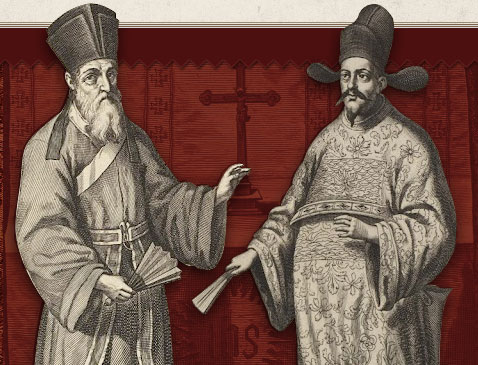
Subject: Perfection--Religious aspects--Catholic Church

Chongxiuyin 崇修引. 第一册
AuthorRodriguez, P.A.Siao, Joseph [Xiao Jingshan 蕭靜山]
PlaceXian Xian 獻縣
PublisherZhangjiazhuang Tianzhutang 張家莊天主堂
CollectionRicci Institute Library
Edition9. éd.
LanguageChinese 中文[繁體]
TypeBook
ShelfAdmin. Office Gallery
Call NumberBV4813.R6 1926
Description667p. ; 18 cm.
NoteChongxiuyin 崇修引. 第一册 / [P. A. Rodriguez, Xiao Jingshan yi 蕭靜山譯].
T.P. also in Latin: De exercitio Christianae perfectionis / P.A. Rodriguez, S.J. Sinice reddidit: P. Ioseph Siao, S.J.
World-perfection and the first being : introduction of scholastic debates into late Ming China by the Jesuits
AuthorZhu Hailin
CollectionRicci Institute Library
LanguageEnglish
TypeArticle (in Periodical)
ShelfDigital Archives
Call NumberB127.L5 Z48 2026
Description21 p.
Note

World-perfection and the first being : introduction of scholastic debates into late Ming China by the Jesuits / Hailin Zhu

Published in Journal of Jesuit Studies vol. 13 issue 1 

Also available through Boston College Libraries

Abstract:
This paper examines the intellectual encounter between Jesuit Scholastic metaphysics and Late Ming neo-Confucian cosmology, focusing on the question of the world’s perfection as introduced in the 1628 work Huanyou quan (Explanation of the great being)—a translation of the Jesuit Coimbra commentary on Aristotle’s De coelo. The introduction of these Western philosophical ideas into Late Ming China, where cosmology was traditionally based on cyclical transformations governed by Li (first principle) and Qi (vital force), sparked a profound intellectual exchange. It prompted Chinese intellectuals to re-evaluate their own metaphysical first being critically. While the Jesuit arguments framed the world’s perfection in terms of divine creation, neo-Confucians emphasized the cosmos’s impermanence and dynamic interplay. The Jesuit emphasis on moral order and theodicy resonated with Confucian concerns about cosmic harmony, leading some Chinese scholars to reinterpret traditional cosmological ideas. This encounter, although it did not reconcile all differences, pushed Chinese scholars to refine their views and contributed to a broader understanding of cosmological perfection that integrated both Western and Chinese thought. Thus, the paper demonstrates that this Sino-Western dialogue was most productive not in achieving doctrinal agreement but in stimulating a sophisticated cross-cultural critique that refined metaphysical arguments on both sides.